
A Solynth Network Treatise
Author: Robert Harvey Curtis (rhc), developed in
collaboration with OpenAI
Version: 1.1
Date: 21 August 2026
Status: RAG-checked analytical essay
Classification: Language, technology, human migration
and cultural evolution
Tags: language convergence, Esperanto, pidgin, creole,
Spanglish, Denglisch, Afrikaans, English as a lingua franca, artificial
intelligence, machine translation
Hero illustration — Beyond Babel. An artistic interpretation of humanity moving from the biblical metaphor of divided languages toward global communication mediated by migration, institutions, networks and translation technology. It is a conceptual illustration, not a data visualization or historical reconstruction.
Human languages have never been sealed containers. They move with people, absorb the vocabulary of trade and conquest, borrow one another’s grammar, and acquire new rhythms wherever communities meet. Esperanto represents the deliberate attempt to design a neutral international auxiliary language. Pidgins and creoles demonstrate what people create without a central designer when communication becomes necessary across linguistic boundaries. Afrikaans shows how a contact-shaped descendant of an older language can become standardized as a language in its own right. Spanglish, Denglisch, Germlish, Llanito and dozens of comparable practices reveal intermediate states: not necessarily new languages, yet no longer mere lists of borrowed words.
Digital networks have now turned much of the planet into a language-contact zone. Technical vocabulary spreads internationally, online speech patterns cross grammatical boundaries, and artificial intelligence increasingly mediates communication between people who do not share a language. These developments make linguistic convergence real, but they do not prove that humanity will eventually speak one uniform language. The more defensible forecast is a layered future: fewer small languages, several large regional languages, a global contact register strongly influenced by English, and near-instant translation connecting the layers. The future may therefore produce not one tongue but a shared linguistic operating layer beneath which human diversity continues.
Imagine humanity 100, 500 or 1,000 years from now. Migration, international families, global commerce and inexpensive travel continue to connect populations that were once separated. Genetic ancestry becomes increasingly mixed in many societies. At the same time, people communicate through global networks, consume the same media, use common technical systems and increasingly speak through machines capable of translating in real time.

Figure 1 — A connected future humanity. This is an artistic illustration of demographic connection and mixed ancestry, not a scientific prediction of a single future appearance. Human populations have always exchanged genes, and modern migration increases admixture in many places, but neither population genetics nor demography predicts one uniform “future human.”
It is reasonable to ask whether languages will follow a path analogous to population admixture. Thousands of historically distinct speech communities might gradually converge, first by borrowing words, then by sharing sentence patterns and cadence, and eventually by settling upon a common world language.
This is a coherent hypothesis, but it is not an established prediction. Genetic ancestry and language are not governed by identical mechanisms. Genes are biologically inherited; languages are socially learned and may be adopted, abandoned or revived within a generation. “Race,” moreover, is primarily a social classification imposed upon patterns of ancestry and appearance, not a set of discrete biological human subspecies. Human admixture is ancient and continuing, but greater gene flow does not logically guarantee one uniform future population. Likewise, greater communication encourages linguistic convergence while identity, geography and social differentiation continually generate divergence.
The central question is therefore not simply whether languages are mixing. They demonstrably are. The question is what kind of destination that mixing makes possible.
Every major language is already a historical composite. English emerged from West Germanic varieties and was transformed through contact with Norse, Norman French, Latin and numerous languages encountered through trade, empire, migration and science. Spanish developed from spoken Latin in Iberia while absorbing Germanic, Arabic, Indigenous American and other influences. Swahili has a Bantu grammatical foundation and a vocabulary shaped by centuries of contact around the Indian Ocean. Modern languages are better understood as rivers with tributaries than as chemically pure substances.
Contact can affect several layers:
An English sentence may therefore contain no German words and still “think in German.” “We see us tomorrow” maps German Wir sehen uns morgen onto English vocabulary. Conversely, a German sentence may use only legitimate German words while reproducing an English internet formula such as “am Ende des Tages” for “at the end of the day.” The deepest linguistic mixing is often invisible at the dictionary level.
Esperanto belongs to the tradition of constructed international auxiliary languages. L. L. Zamenhof published its first manual in Warsaw in 1887. Raised in multilingual Białystok, then within the Russian Empire, he believed that a relatively accessible shared language could reduce misunderstanding among communities divided by language, religion and ethnicity.
Esperanto was not intended to erase first languages. It was proposed as a politically neutral second language: a common bridge that would not grant the native speakers of a dominant national language an automatic advantage. Its spelling is regular, its grammar deliberately limited in irregularity, and its system of roots and affixes allows speakers to construct related words predictably.
Esperanto succeeded in ways that many planned languages did not. It developed literature, associations, international gatherings and even some native speakers raised in Esperanto-speaking homes. It did not, however, become the world’s general auxiliary language. Political and economic power favoured natural languages attached to states and empires—especially English—rather than a comparatively neutral designed system.
The lesson is important. Linguistic efficiency alone does not determine adoption. A world language needs networks of speakers, institutions, education, media, employment and prestige. Languages spread because people need or desire access to the worlds conducted through them. Esperanto designed the bridge but could not manufacture the global traffic.
Pidgins arose historically in settings where groups without a shared language needed a restricted means of communication, often for trade, labour or administration. A pidgin is not “bad” or childish language. It is a functional contact system with conventions learned by its users. In the classic definition it initially has no native speakers and serves limited domains.
The familiar schoolbook story says that when children acquire a pidgin as a first language, it expands into a creole. That account captures an important process but is too simple as a universal history. Contemporary scholarship emphasizes that pidgins and creoles emerged under varied colonial and social conditions. Some creoles did not pass through a clearly documented, stable pidgin stage, and their development involved continuous interaction among speakers rather than a single moment of linguistic birth.
Creoles are complete natural languages. Haitian Creole, Tok Pisin, Jamaican Patwa and other contact languages are capable of expressing the full range of human experience. Their grammars are systematic even where colonial observers mischaracterized them as corrupted versions of European languages.
Pidgins and creoles demonstrate three principles central to the future-language question:
Contact can therefore produce both convergence and a new form of diversity.
Afrikaans is fundamentally descended from seventeenth-century Dutch spoken at the Cape, not a simple Dutch-English blend. Its Dutch foundation was reshaped through contact among European settlers, Indigenous Khoikhoi and San communities, enslaved people brought from Asia, Madagascar and Africa, Cape Muslim communities, and later English speakers.
Its development included grammatical regularization, characteristic constructions and vocabulary acquired through multiple routes. Some early substantial Afrikaans writing was produced in Arabic script by Cape Muslim writers, an important corrective to the later political mythology that treated Afrikaans as the exclusive creation and property of white Afrikaners.
Afrikaans illustrates a threshold. What outsiders once dismissed as broken or simplified Dutch acquired stable community transmission, a literature, standardized spelling, institutions and political recognition. It became indisputably a language. Yet its history also warns that language cannot be separated from power: Afrikaans was later appropriated by Afrikaner nationalism and the apartheid state, while simultaneously remaining the language of many coloured South Africans and of writers resisting apartheid.
No linguistic mixture is socially neutral. Who is permitted to name a language, teach it, publish it and declare one variety “correct” is always a question of authority.
Spanglish is a broad label for Spanish-English bilingual practices, especially in the United States and Puerto Rico. It is not one uniform language. Mexican-American usage in Texas or California differs from Puerto Rican usage in New York and Cuban-influenced usage in Miami. It may involve code-switching, English loanwords adapted to Spanish morphology, literal translations, transferred rhythm and shared cultural references. In established bilingual communities it can communicate intimacy and identity, not linguistic incompetence.
Denglisch commonly describes German containing English vocabulary or constructions, especially in technology, advertising, academia and business. “Das Team updaten” places an English-derived verb inside German grammar. Germlish or the spontaneously coined “Germinglish” can describe still freer mixtures. These labels are humorous, but the mechanisms are real.
Gibraltar’s Llanito combines Andalusian Spanish, British English and vocabulary from the territory’s Mediterranean history. Belizean communities may move among Spanish, English and Belizean Kriol. Hinglish, Taglish, Singlish, Manglish, Franglais, Portuñol and numerous other labels describe distinct social realities, not interchangeable versions of one global hybrid.
These varieties occupy different positions on a continuum:
borrowing → code-switching → structural transfer → stable contact variety → standardized language
There is no law requiring movement to the right. A mixed practice may remain fluid for centuries. A standardized language may later split. The continuum describes possibilities, not destiny.
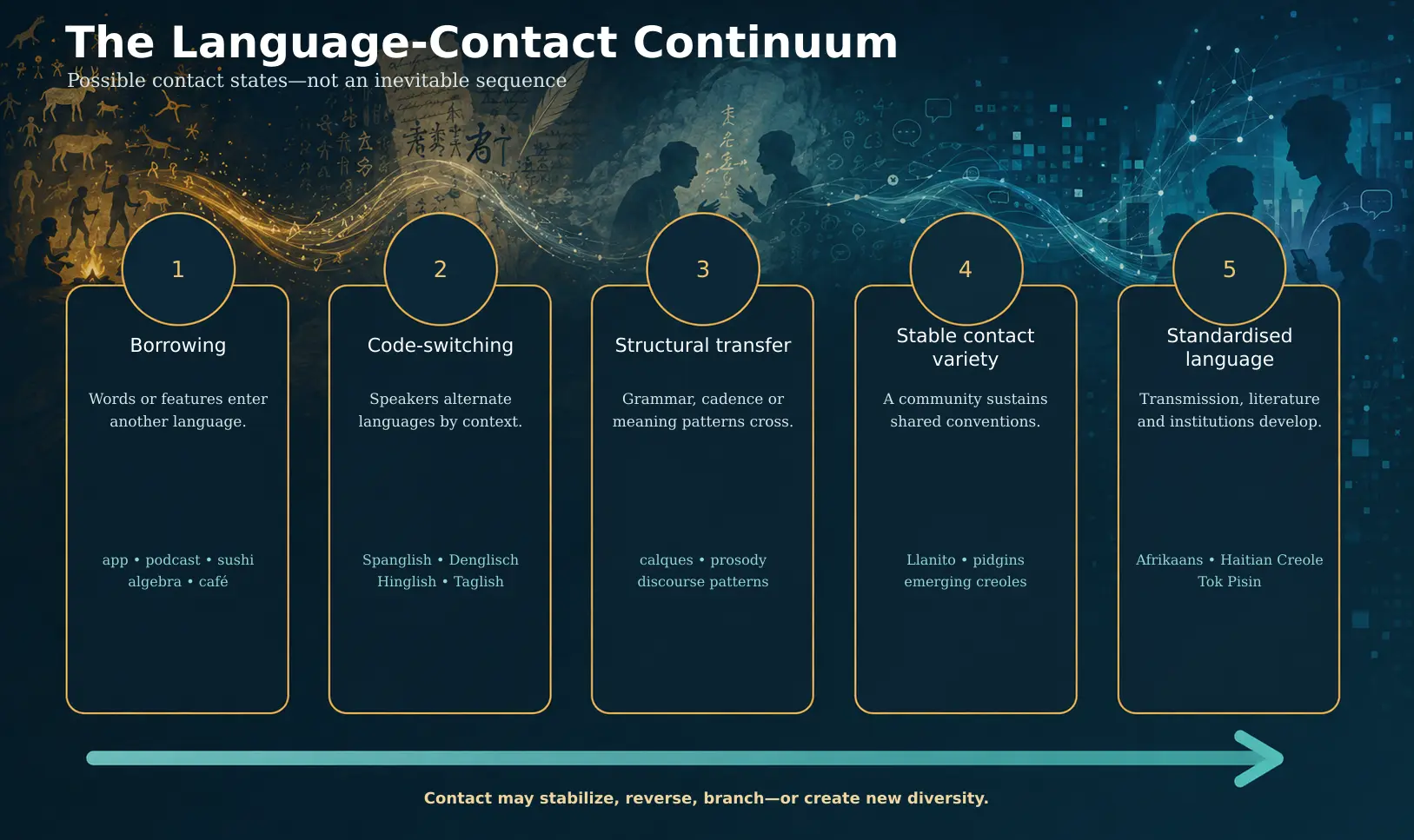
Figure 2 — The Language-Contact Continuum. Borrowing, code-switching, structural transfer, stable contact varieties and standardised languages are possible states of language contact, not compulsory stages. A community may remain in one region of the continuum, move in either direction, or generate several new varieties. The examples are illustrative and sometimes overlap categories.
Before digital communication, deep language contact generally required migration, conquest, trade, schooling or physical proximity. The internet allows a person to inhabit another language for hours each day without leaving home.
A German speaker may work in English-language software, watch American video, play games with an international team, message friends in German and listen to British podcasts. The result is not merely imported terminology. Repeated formats enter thought and speech: “Here’s the thing,” “not going to lie,” “at the end of the day,” “let that sink in,” or “tell me you are X without telling me you are X.” Other languages reproduce these templates with local words, sometimes awkwardly at first and naturally later.
Algorithms accelerate the process. Successful phrases are copied across platforms. Memes reward repeatable structures. Subtitles allow foreign cadence to accompany local text. Podcasts expose listeners to extended rhythms of speech. Gaming creates real-time multilingual teams. Influencers turn bilingual identity into a public style. Large language models generate and translate more text than any earlier human institution.
The internet therefore acts simultaneously as:
UNESCO reports that roughly 7,000 spoken or signed languages remain in use and that a large share are endangered. It has also warned that online resources are heavily concentrated among a small number of major languages. Digital technology can rescue a language by making teaching, keyboards and archives available—or make abandonment more attractive by rewarding movement into a dominant language.
Technology already produces a partial international lexicon. Words derived from internet, software, Wi-Fi, app, podcast, streaming, cloud, server, login, and AI appear across languages, sometimes translated and often adapted to local pronunciation and grammar.
This does not mean that everyone is using the same language. A shared command vocabulary resembles the international systems used by pilots, scientists, musicians or programmers: it creates interoperability within a domain. The underlying conversation may remain Arabic, Japanese, Portuguese or Polish.
Programming languages add a further layer. Their reserved words are often English-derived, but code is not a natural human language. It is a formally constrained notation interpreted by machines. Nevertheless, global technical work normalizes English labels and encourages common conceptual metaphors: folders, windows, clouds, cookies, streams and agents.
In this sense, technology is building the semantic infrastructure of a world register before it builds a world language.
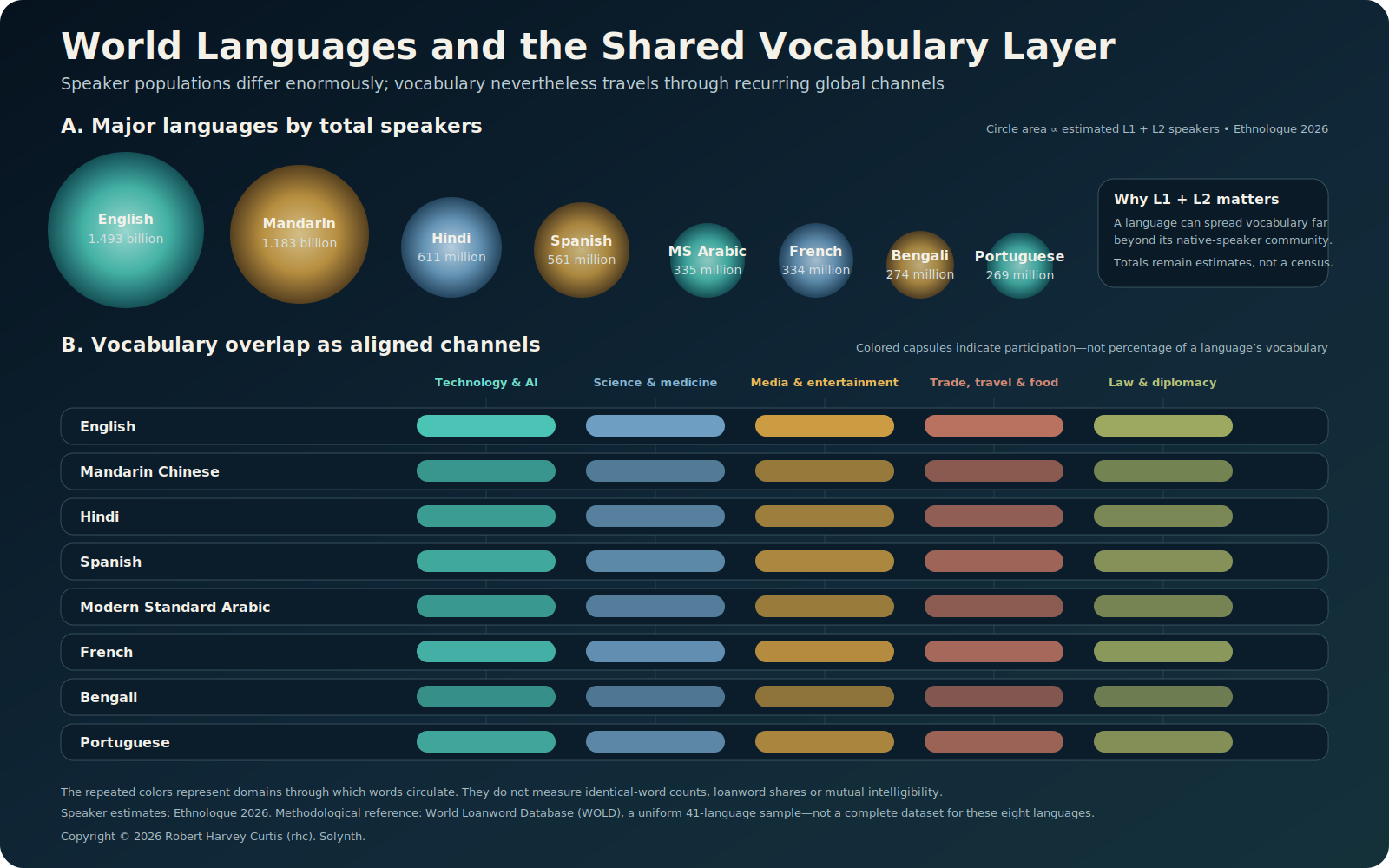
Figure 3 — World languages and the shared vocabulary layer. Circle area represents estimated total first- and second-language speakers for eight of the most widely spoken languages in Ethnologue’s 2026 table. The aligned colored capsules below are qualitative: they identify recurring channels through which vocabulary circulates—technology, science and medicine, media, commerce and travel, and law and diplomacy—but do not claim measured percentages of borrowed or identical words. Comparable lexical-overlap figures do not presently exist for all eight languages under one uniform method. The World Loanword Database supplies a rigorous model for studying borrowing, but its sample contains only 41 languages and cannot support a complete eight-language comparison here.
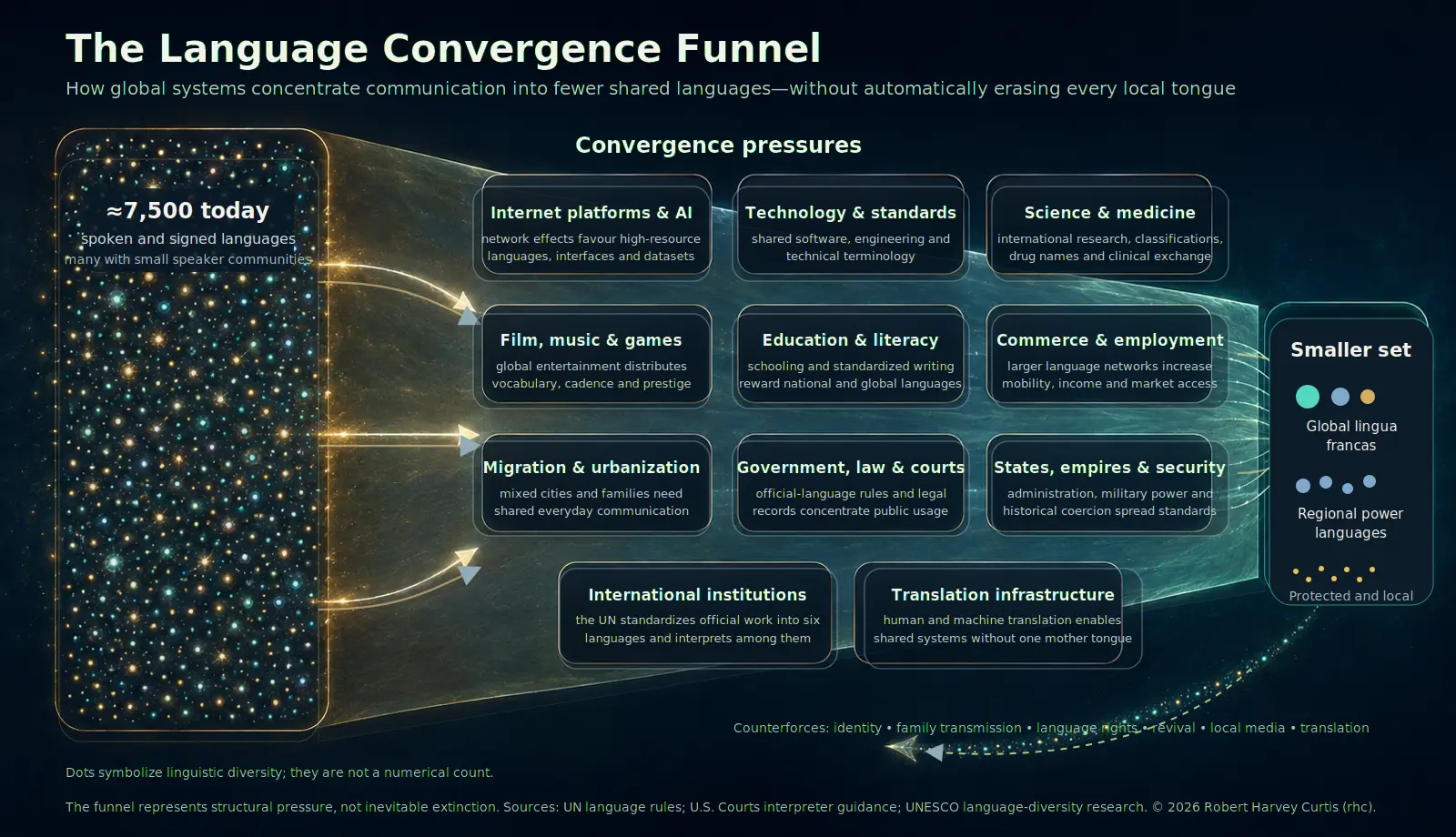
Figure 4 — The Language Convergence Funnel. Thousands of local languages encounter technological, economic, institutional and demographic pressures that concentrate communication into a smaller set of global and regional languages. This is a structural map, not a quantified causal model or a prediction of inevitable extinction. International institutions are also more multilingual than an English-only account would suggest: the United Nations conducts official work in six languages and interprets among them. Translation is double-edged—it can strengthen dominant communication networks, but it can also help smaller languages remain usable.
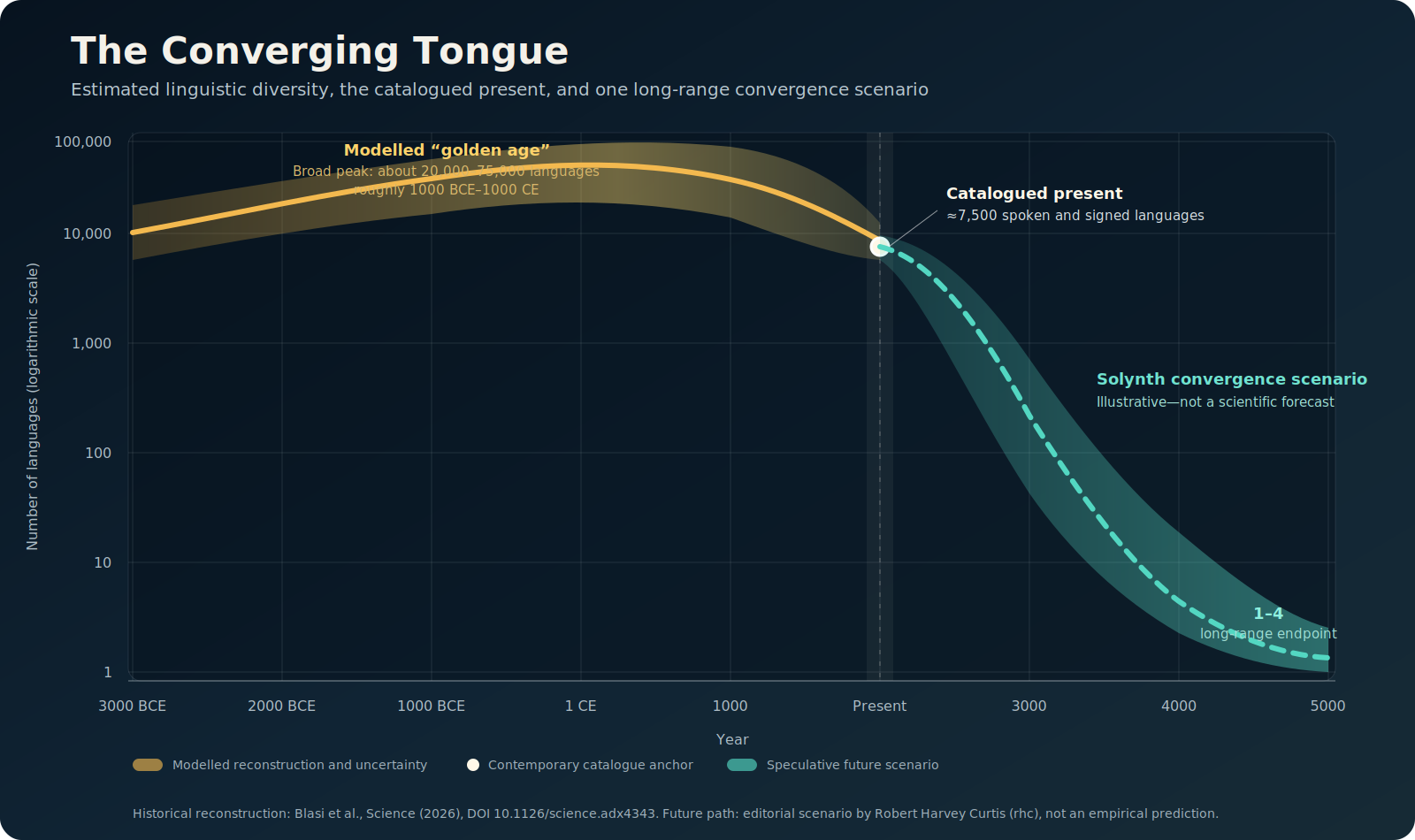
Figure 5 — The Converging Tongue: past, present and one possible future. The gold section is a broad model-informed reconstruction derived from the shape and ranges reported by Blasi and colleagues in Science (2026), not a census of ancient languages. The white point marks the contemporary catalogue estimate of approximately 7,500 spoken and signed languages. The teal section is the Solynth convergence scenario proposed in this treatise: a deliberately speculative path toward one to four languages over the next three millennia. The vertical axis is logarithmic so that both the historical peak and the proposed endpoint remain legible. No scholarly model currently establishes the teal trajectory.
The accompanying Language Motion Lab turns the article’s broad convergence hypothesis into a parameterized visual experiment. It distinguishes modelled past, current estimates and speculative future scenarios; lets readers disable non-observed layers; and provides controls for playback, scale and long-range assumptions. It is a demonstration of how such scenarios can be explored, not a validated forecast.
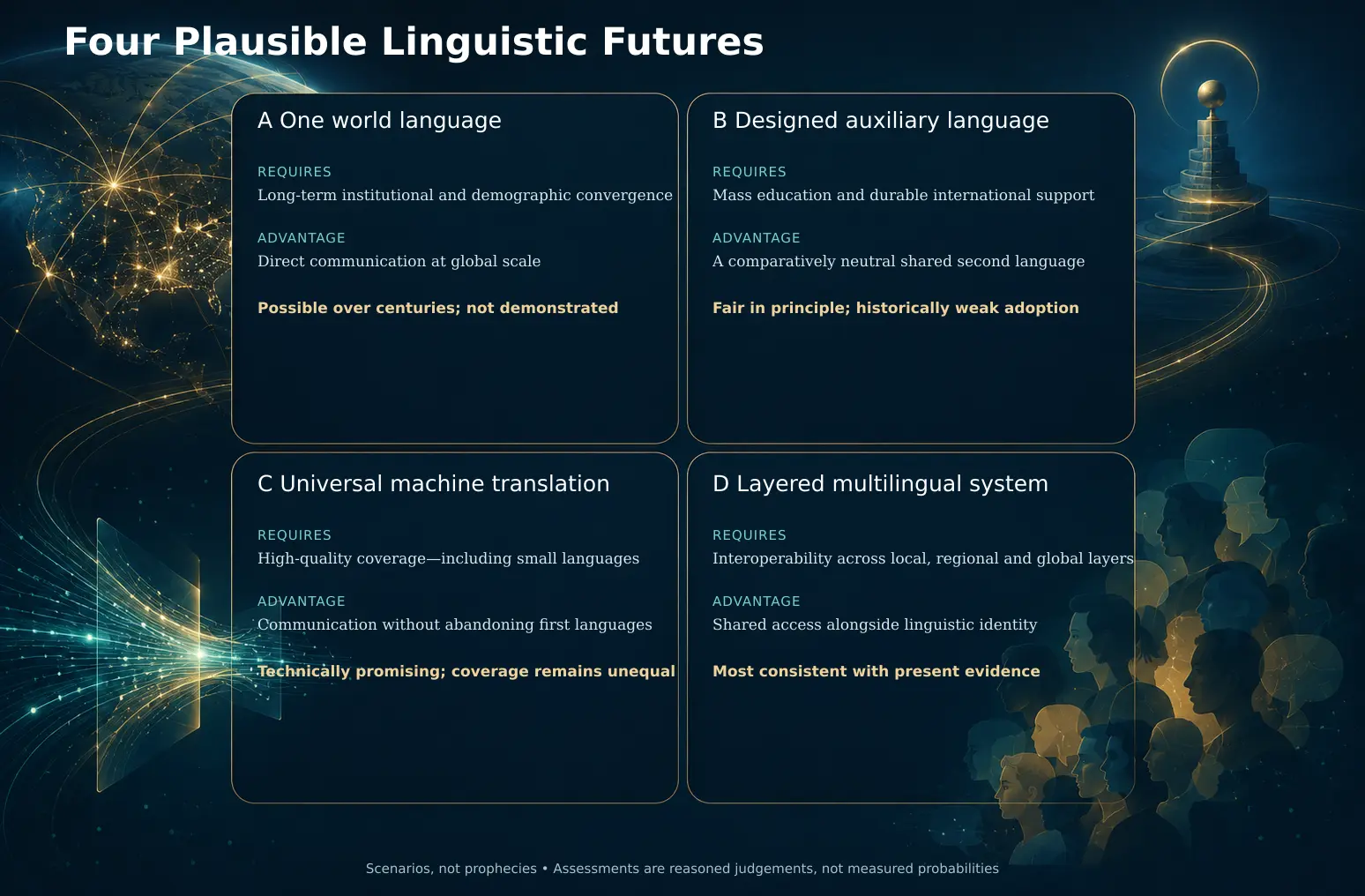
Figure 6 — Four plausible linguistic futures. These scenarios are not assigned numerical probabilities. The comparison summarizes the institutional requirements, principal advantage and evidential standing of each possibility. The layered multilingual system is described as most consistent with present evidence, not guaranteed.
In the strongest convergence scenario, migration, intermarriage, education and media gradually reduce language diversity until most people speak descendants of a single global language. English is the leading contemporary candidate, but over centuries it would change so deeply—and absorb so much from its users—that calling the outcome “English” might be historically misleading.
This future is possible but not demonstrated. Latin once appeared dominant across an empire, yet developed into multiple Romance languages. Political unity can standardize speech, but separation and identity repeatedly generate new varieties.
Humanity might select Esperanto, Interlingua or a future designed language as a neutral global second language. Its political fairness could become attractive if resistance grows to the advantages enjoyed by native English speakers.
The historical weakness is adoption. Without enormous institutional support, a planned language competes poorly with a language already embedded in commerce, entertainment and education.
Near-real-time machine interpretation could allow everyone to retain a first language while software handles communication. In this future there is no reason to surrender linguistic identity merely to conduct business or travel.
This could protect diversity, but only if translation systems support small languages. If high-quality tools exist for six major languages while thousands receive little data or investment, technology may accelerate consolidation rather than prevent it. Translation also risks smoothing culturally specific concepts into the patterns best represented in its training material.
This is the most evidence-consistent scenario. People retain local or identity languages, use national or regional standards for public life, share a global lingua franca or contact register, and employ machines between all three.
A future citizen might speak a family language at home, a national language in civic life, a global English-derived register for international work, specialized technical notation with machines, and translation-mediated speech with everyone else. These layers would influence each other continually.
The result would be convergence without complete uniformity: not one language, but a globally interoperable ecology.
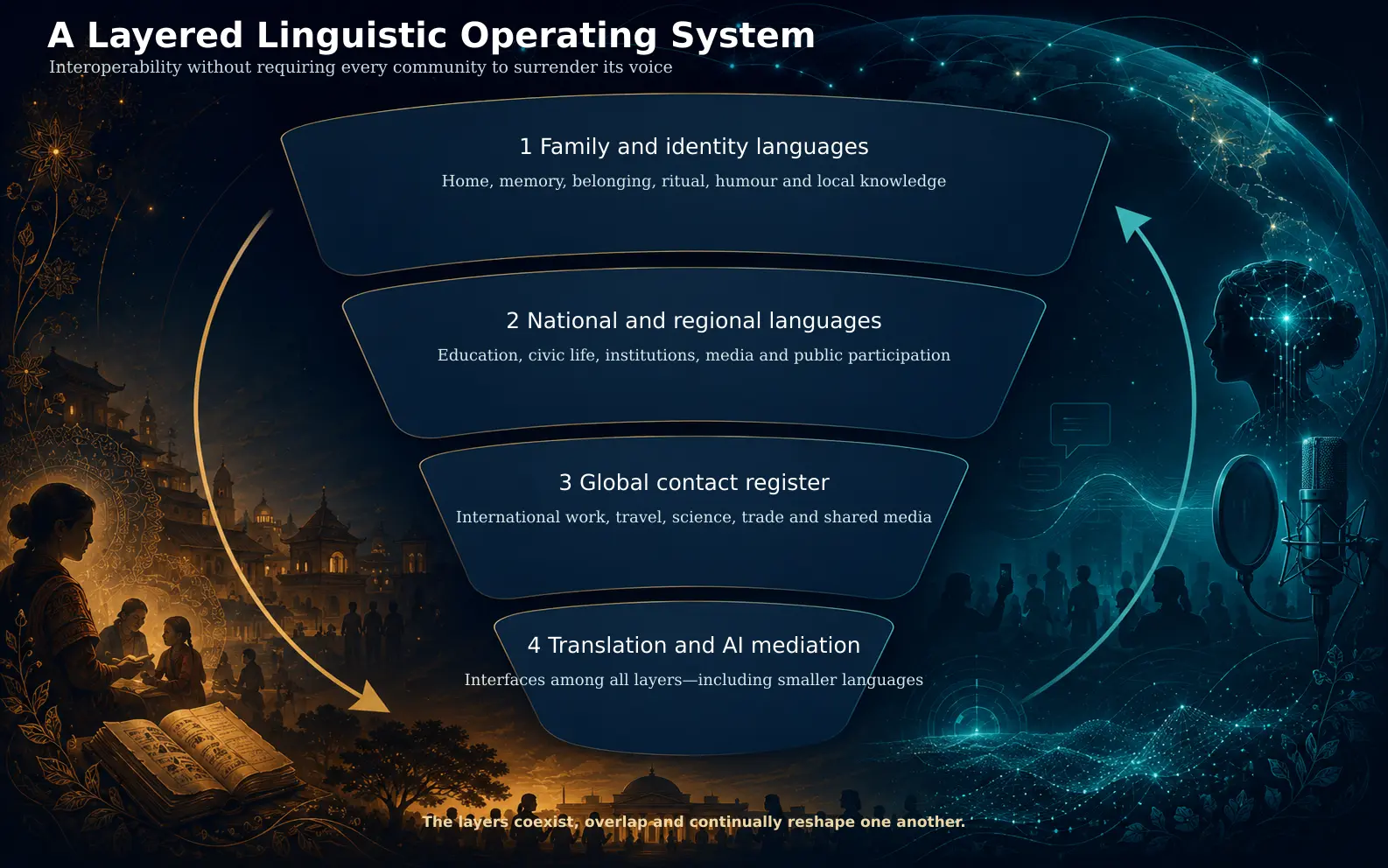
Figure 7 — A Layered Linguistic Operating System. Family and identity languages, national and regional languages, a global contact register, and translation technology can coexist. The arrows are bidirectional because vocabulary, cadence, grammar and cultural expectations can move among all four layers. This is the Solynth synthesis advanced by the article, not an established linguistic model.
Human history contains repeated population admixture. Genomic research confirms that gene flow among previously separated populations has been common and that mixed ancestry can increase diversity within populations. Modern migration continues this process in many regions.
But “one future race” is not a precise scientific prediction. Patterns of partnership are uneven; geography and culture continue to structure populations; visible traits do not blend toward one predetermined average; and racial categories can persist socially even as ancestry becomes more complex.
The linguistic analogy works best at the level of networks. Increased contact moves features across former boundaries. It works poorly if interpreted as inevitable homogenization. Languages can be learned by people with no ancestral relationship to their earlier speakers. They can be deliberately revived, as Modern Hebrew was, or protected through schooling. They can also become stronger symbols of difference precisely because globalization threatens them.
Both ancestry and language are likely to become more interconnected. Neither is guaranteed to become uniform.
The Converging Tongue is not a proposed vocabulary or a replacement for Esperanto. It is a model of direction. It describes the emerging shared layer created by five forces:
Its likely base is not “pure English.” It is English used predominantly by people for whom English is not the first language, simplified or regularized in some contexts, enriched elsewhere, and continually translated through other conceptual systems. The world language, if it comes, may emerge not from native speakers exporting a fixed standard but from billions of second-language speakers collectively rebuilding it.
This possibility resembles creolization only metaphorically and should not be labelled a creole without evidence of the relevant social and linguistic history. “Global contact register” is the safer present term.
Several powerful forces resist complete convergence:
The paradox is that the same internet that spreads global formulas also lets small communities organize, teach and publish. Convergence and diversification are not opposing historical eras. They occur at the same time.
Humanity is plainly moving into an era of denser biological, cultural and linguistic connection. Mixed ancestry is increasingly ordinary in many societies. Mixed speech is increasingly visible. Technical language is becoming globally interoperable, and machine translation is beginning to separate mutual understanding from the requirement to share a mother tongue.
These are genuine intermediary developments, but the final destination remains open. A single world language is possible across a horizon of centuries, particularly after extreme political integration or prolonged off-world settlement. It is not inevitable, and the historical tendency of languages to divide is as real as their tendency to converge.
The most plausible future is therefore not silence for every language except one. It is a layered human conversation: local languages preserving memory and identity, regional languages organizing societies, a shared global register enabling cooperation, and machines translating among them. Beneath that arrangement, cadence, metaphor and grammar will continue leaking across every boundary.
The Converging Tongue has already begun. It is not yet a language. It is the growing capacity of humanity’s languages to think through one another.
Admixture: Gene flow between populations with previously differentiated ancestry. It is not synonymous with the disappearance of all population structure.
Auxiliary language: A language used to enable communication among people with different first languages. It may be natural or constructed.
Borrowing: Adoption of a word or feature from another language.
Calque: A loan translation that reproduces the structure of a foreign expression using local words.
Code-mixing: The combination of material from more than one language within an utterance or discourse. Usage overlaps with code-switching.
Code-switching: Alternation between two or more languages or varieties according to context, audience or conversational purpose.
Constructed language (conlang): A language consciously designed by an individual or group rather than arising entirely through ordinary historical transmission.
Contact language: A language or variety emerging from sustained communication among speakers of different languages.
Creole: A stable natural language associated with intensive language contact. The traditional claim that every creole develops from a nativized pidgin is not accepted as a universal historical rule.
Denglisch: Informal label for German speech or writing containing conspicuous English vocabulary or constructions.
Esperanto: The constructed international auxiliary language published by L. L. Zamenhof in 1887.
Global contact register: A proposed descriptive term for shared international patterns of vocabulary, grammar and discourse used across first-language boundaries.
Lexifier: The language supplying a large portion of a contact language’s vocabulary; it is not necessarily the sole source of its grammar.
Lingua franca: A shared language used among speakers with different first languages.
Pidgin: A contact variety conventionally defined as serving restricted communicative purposes and initially having no native speakers.
Prosody: Rhythm, stress, pitch and intonation in speech.
Spanglish: A broad, non-uniform label for Spanish-English bilingual practices, particularly in the United States and Puerto Rico.
Translanguaging: A framework emphasizing how multilingual speakers draw upon an integrated communicative repertoire rather than operating with perfectly sealed language systems.
| Claim | Starting source or proposition | Independent verification | Status |
|---|---|---|---|
| Esperanto was introduced by Zamenhof in 1887 as an international auxiliary language. | General historical accounts | Annual Review of Linguistics overview of constructed languages; contemporary historical summaries of the 1887 manual | Verified |
| Pidgins are conventionally restricted contact varieties without native speakers. | Standard linguistic definition | Cambridge Handbook of Linguistic Typology | Verified with qualification |
| Every creole necessarily begins as a pidgin learned by children. | Traditional textbook account | Mufwene’s University of Chicago review and modern creole scholarship | Not universally supported; explicitly qualified |
| Afrikaans is basically Dutch mixed with English. | Common popular assumption | Historical linguistics identifies seventeenth-century Cape Dutch as the primary ancestor, with multiple contact influences and later English influence | Rejected as inaccurate |
| Spanglish is a single standardized language. | Popular label | Research documents multiple geographically and socially distinct Spanish-English practices | Rejected as inaccurate |
| The internet is dominated by a relatively small set of major languages. | User hypothesis about technological ubiquity | UNESCO digital-language reporting | Verified in broad form |
| At least 40% of the world’s roughly 7,000 languages are endangered. | UNESCO public reporting | UNESCO multilingual-education and language-diversity materials | Verified as UNESCO estimate; figures depend on definitions and datasets |
| Machine translation will preserve all languages. | Optimistic future scenario | EU and UNESCO analyses warn of unequal technological coverage | Unsupported as a certainty |
| Global migration is increasing admixture in many populations. | Analogy proposed in the essay | Population-genomic reviews document recurrent historic and modern admixture | Verified in broad form |
| Humanity is predictably becoming one biologically uniform race. | Strong version of analogy | Population genetics supports admixture but not a predetermined uniform endpoint; race is not a set of discrete biological subspecies | Not established; rejected as a scientific prediction |
| Humanity will eventually speak one world language. | Central future hypothesis | No empirical method can verify a 100–1,000-year linguistic outcome; historical evidence supports both convergence and divergence | Plausible but speculative |
| A layered multilingual system is more likely than immediate total convergence. | Synthesis in this treatise | Consistent with present lingua-franca research, multilingual practice and translation trends | Reasoned inference, not a verified prediction |
The historical and definitional portions of this treatise are well supported by linguistic and institutional sources. The long-term forecast is necessarily inferential. No source can verify the linguistic condition of humanity 500 or 1,000 years from now. Accordingly, the article treats the single-world-language outcome as a hypothesis and identifies the layered multilingual future as the scenario most consistent with currently observable evidence—not as a certainty.
Copyright © 2026 Robert Harvey Curtis (rhc). All rights
reserved.
Powered by The Solynth Network
Learning • Exploring • Creating • Connecting
Solynth is people. Because people are the purpose.